
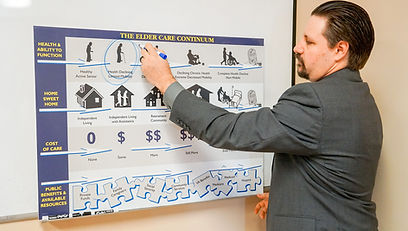
Life Care Planning Journey for Families
This page walks you through the key decisions and next steps in planning for your family’s future.
Most families do not come to elder law planning with one isolated question. They come with a situation: a new diagnosis, a spouse who needs more help, an aging parent who is no longer safe alone, a child who relies on benefits, or a concern about how to pay for care without losing everything.
That is why these FAQs are organized around Life Care Planning. Estate planning, long-term care planning, Medicaid planning, crisis planning, and special needs planning all connect. The goal is not simply to prepare documents. The goal is to help families stay in control, find good care, support caregivers, protect resources when the law allows, and preserve dignity through each stage of life.
If one of these questions sounds familiar, the next step is a planning appointment. That appointment lets us apply these general principles to your family, your documents, your care needs, and your goals.

Start Here: What Kind of Planning Do You Need?
What is Life Care Planning
Life Care Planning is a coordinated approach to aging, chronic illness, and long-term care. It looks at the legal, financial, care, and family pieces together instead of treating them as separate problems.
A Life Care Plan asks practical questions:
-
Who has legal authority to help if you cannot make decisions?
-
What care is needed now, and what care may be needed next?
-
Can care be provided safely at home, or is a higher level of care needed?
-
How will care be paid for?
-
Are Medicaid, KanCare, Veterans benefits, long-term care insurance, or other resources available?
-
Who is supporting the caregiver?
-
How do we protect dignity, independence, and family stability as needs change?
This type of planning is especially important when a family is facing Alzheimer's disease, dementia, Parkinson's disease, stroke, frailty, or another chronic condition that may unfold over months or years.
A planning appointment helps turn these questions into a clear next-step plan.
What is the difference between Life Care Planning, long-term care planning, and estate planning?
These three types of planning are connected, but they answer different questions.
Estate planning
Estate planning answers: What happens to my resources, and who can act for me if I cannot act for myself? It often includes Wills, Trusts, powers of attorney, healthcare directives, and beneficiary designations. Good estate planning reduces confusion, avoids unnecessary court involvement when possible, and helps carry out your wishes.
Long-term care planning
Long-term care planning answers: What happens if I need help while I am living? It focuses on care options, care costs, insurance, Medicaid eligibility, asset protection strategies, and how to support a spouse or caregiver.
Life Care Planning
Life Care Planning brings those pieces together. It asks: How do we manage care, legal decisions, benefits, finances, and family support now and over time? It is a team-based approach for families who need more than a document. They need a guide, a plan, and a way to adjust when life changes.
For many families, the planning need begins with estate planning. But once chronic illness, caregiver strain, or long-term care costs enter the picture, the plan usually needs to become broader.
What is the difference between Life Care Planning, long-term care planning, and estate planning?
The best time to create a Life Care Plan is when there is a chronic condition or growing concern, but before there is a crisis.
You should consider a planning appointment if:
-
You or a loved one has been diagnosed with Alzheimer's disease, dementia, Parkinson's disease, stroke-related impairment, or another chronic or progressive condition.
-
You are noticing memory changes, falls, unsafe driving, medication problems, unpaid bills, or declining personal care.
-
A spouse or adult child has become the primary caregiver and the demands are increasing.
-
You want to keep a loved one at home as long as safely possible, but you are not sure how to do that.
-
You are worried about paying for in-home care, assisted living, memory care, or nursing home care.
-
You need clarity before a hospital discharge, rehabilitation stay, or nursing home admission.
Starting early gives families more choices. It allows the person affected to participate in decisions while they still can, helps preserve more planning options, and gives caregivers a clearer path forward.
It is rarely too early to plan. It is also often not too late. Even in a crisis, there may be steps that improve care, reduce stress, and protect resources.
Build the Legal Foundation
Do I need a will or trust
The better question is not simply whether you need a Will or a Trust. The better question is: What plan fits your life, your family, your health concerns, and your goals?
A Will is important because it directs where certain property goes after death and names the person who will handle your estate. Most people should have a Will. But a Will usually does not avoid probate by itself, and it does not help your family manage assets during your lifetime if you become incapacitated.
A Trust can be useful when a family wants more privacy, smoother administration, better control over distributions, and a way to manage assets if illness or incapacity occurs. Many families we work with benefit from a Trust, especially when they want to avoid unnecessary court involvement and make things easier for their spouse or children.
The supporting documents matter too. Durable powers of attorney, healthcare powers of attorney, living wills, HIPAA authorizations, and careful beneficiary designations may be just as important as the Will or Trust.
A strong estate plan should answer two questions:
-
What happens to my resources when I die?
-
How does this plan help me and my family if I face Alzheimer's disease, dementia, Parkinson's disease, stroke, or another chronic condition?
If you do not create a plan, Kansas law and the court system may make decisions for you. Your spouse or children may not automatically have the authority you assume they have. Most families prefer to make those decisions themselves, in advance, with clarity and purpose.
A planning appointment helps determine whether a Will-based plan, a Trust-based plan, or a broader Life Care Plan best fits your situation.
Can estate planning help avoid probate?
Yes. When structured properly, estate planning can reduce or even avoid probate.
Probate is the court process for transferring certain assets after death. It can involve court oversight, delays, added expense, public filings, and loss of control. Assets held in a properly funded Trust, or assets with valid beneficiary designations, may pass without probate.
But avoiding probate is only part of the picture. Many families are equally concerned about what happens if health changes during life. If you develop Alzheimer's disease, dementia, or another chronic condition and do not have proper legal authority in place, your family may need a guardianship or conservatorship through the court before they can help.
A thoughtful plan looks at both stages: incapacity during life and transfer after death. It considers how assets are titled, who has authority to act, how care decisions will be made, how family members will be supported, and how your wishes will be carried out with as little disruption as possible.
If your main goal is to avoid court involvement, an appointment can help identify whether the risk is probate, guardianship, conservatorship, or all three.
Plan for Care and Costs
When should I start long-term care planning?
Earlier than most people think.
Long-term care planning is most effective before a health crisis. Planning early gives you more options, more flexibility, and stronger legal and financial protections than trying to make decisions under pressure.
The ideal time to plan is while you are healthy. That allows you to choose decision-makers, update legal documents, coordinate assets, review insurance, protect family financial security, and create a plan that supports independence and dignity.
A diagnosis is also a clear signal to plan. If you or a loved one receives a diagnosis of Alzheimer's disease, dementia, Parkinson's disease, stroke-related impairment, or another chronic illness, start planning right away. There may still be time to preserve resources, choose trusted helpers, and make decisions before a crisis.
Waiting until nursing home care is urgently needed narrows the options. Families may face higher out-of-pocket costs, fewer planning strategies, and more stress during an already difficult time.
That said, it is often not too late. Even after a hospitalization, rehabilitation stay, or nursing home admission, there may be steps available.
If you are wondering whether it is too early or too late, that is usually a good reason to schedule a planning appointment.
How do I pay for long-term care without losing my assets?
This is one of the most common and most important questions families ask.
Paying for long-term care does not always mean losing everything you have built. With proper planning, many families are able to receive needed care while protecting a spouse, a home, and part of the family's resources.
Long-term care is typically paid for in one or more of four ways:
-
Private pay from income or savings
-
Long-term care insurance
-
Limited Medicare coverage for short-term skilled care
-
Medicaid, called KanCare in Kansas, for eligible long-term care needs
For many middle-class families, Medicaid becomes the primary safety net because Medicare does not pay for ongoing custodial care, such as help with bathing, dressing, supervision, and daily support due to dementia.
Medicaid has strict income and asset rules, but it does not require total impoverishment. In Kansas, certain assets are generally treated differently than cash or investments. Depending on the facts, this may include a home, one vehicle, personal belongings, certain life insurance, prepaid funeral and burial arrangements, and income-producing property such as farm ground or rental property.
For married couples, additional protections may apply for the spouse at home. These rules can protect certain resources and may allow some income from the spouse in care to be used for the spouse at home.
Planning in this area may involve coordinating income, using exempt resources appropriately, converting countable resources into non-countable resources when allowed, and preparing the Medicaid application correctly.
Problems often arise when families act without a plan, such as giving assets away, adding children to accounts, transferring a home, or spending down money unnecessarily. Those steps can create penalties, delay eligibility, or reduce options.
A long-term care planning appointment helps identify the safest way to pay for care, protect dignity, and preserve resources when the law allows.
Understand Medicaid and KanCare
Can Medicaid help cover the costs of long-term care?
Yes. Medicaid can be a major resource for covering long-term nursing home care when a person qualifies. In Kansas, Medicaid is administered through KanCare.
Medicare and Medicaid are often confused. Medicare may cover short-term skilled care after a qualifying hospital stay, but it does not generally pay for long-term custodial care. Conditions like Alzheimer's disease, Parkinson's disease, dementia, and frailty often require support that lasts far longer than Medicare will cover.
Medicaid may help pay for long-term nursing home care once the applicant meets the medical, income, and asset rules. The challenge is that eligibility is not automatic. The rules are detailed, and the order of decisions matters.
Used correctly, Medicaid planning can help a family move from fear and confusion to a more stable care plan. Used incorrectly, it can become frustrating, overwhelming, and expensive.
If care costs are rising, or a nursing home admission is likely, a Medicaid planning appointment can help you understand what is protected, what must be spent, and what should not be touched without advice.
Must I spend all of my assets down to less than $2,000 to qualify for Medicaid?
No. You do not necessarily have to spend all of your assets down to less than $2,000 to qualify for Medicaid.
The $2,000 figure is often discussed because, in Kansas, the person applying for long-term care Medicaid may generally be limited to $2,000 in countable resources. But not everything is counted the same way. Medicaid rules distinguish between countable and non-countable resources.
Certain resources may be protected or treated differently, depending on the facts. These may include a home within applicable limits, one vehicle, personal belongings, prepaid funeral and burial arrangements, certain life insurance, income-producing property, and specific protections for a spouse at home.
That is why a simple spend-down answer can be dangerous. Some families spend money unnecessarily because they assume everything must be gone before Medicaid will help. Others give assets away or retitle property and accidentally create a penalty.
An elder law plan reviews assets, income, expenses, care costs, ownership, beneficiary designations, and family goals before recommending any spend-down strategy.
Before spending, gifting, retitling, or adding a child to an account, schedule a planning appointment. The right sequence can make a meaningful difference.
What is Division of Assets, and when should we do that?
Division of Assets is the common term for the spousal impoverishment rules under federal Medicaid law. It applies when one spouse needs nursing home care and the other spouse remains at home.
The purpose is to protect the spouse at home from financial hardship while the spouse in care qualifies for Medicaid. The law recognizes that it makes little sense to impoverish both spouses when only one needs nursing home care.
When these rules apply, the couple's assets are reviewed. Some assets may not be counted, such as the home, personal belongings, one vehicle, and certain income-producing property. The remaining countable assets are then measured under Medicaid rules.
As of 2026, the spouse at home may keep one-half of the countable assets up to a maximum Community Spouse Resource Allowance of $162,660, adjusted annually. The spouse needing care typically must reduce countable resources to the Medicaid limit, often $2,000 in Kansas.
Medicaid also protects a minimum level of income for the spouse at home. As of 2026, the Minimum Monthly Maintenance Needs Allowance is $2,643.75 per month, adjusted annually. If the spouse at home's income is below that amount, a portion of the nursing home spouse's income may be shifted to the spouse at home.
Example: If the spouse at home's monthly income is $800 and the protected monthly need is $2,643.75, the shortfall is $1,843.75. Depending on the rules and the facts, up to that amount of the nursing home spouse's income may be directed to the spouse at home instead of being paid toward care.
Division of Assets is most effective before assets are spent down unnecessarily. It can also help after a spouse has already entered a nursing home, but timing and documentation matter.
If one spouse is in a nursing home, about to enter a nursing home, or paying privately for care, schedule a Division of Assets appointment before assuming the money must simply be spent.
Respond to a Care Crisis
How do I know when it is no longer safe for someone to live at home, and what should I do next?
It may no longer be safe for someone to live at home when daily risks begin to outweigh independence.
Common warning signs include frequent falls, wandering or getting lost, unsafe driving, missed medications, unpaid bills, financial confusion, declining hygiene, repeated emergency room visits, increased confusion, and unsafe use of appliances or firearms. Caregiver strain matters too.
Exhaustion, resentment, declining health, or feeling constantly overwhelmed are signs that the current plan may no longer be sustainable.
When these signs appear, the goal is not to take away independence. The goal is to find the safest level of support that preserves as much dignity and independence as possible.
The next steps are usually:
-
Assess the situation clearly. A second perspective from family, a physician, a care coordinator, or another professional can help confirm what is happening.
-
Understand the care options. The choice is not simply home or nursing home. Options may include in-home care, adult day programs, assisted living, memory care, rehabilitation, or skilled nursing.
-
Confirm legal authority. Durable powers of attorney for finances and healthcare can allow trusted helpers to act without going to court.
-
Create a plan for paying for care. Long-term care is expensive, but proper planning may help protect a spouse, a home, and part of the family's resources.
-
Support the caregiver. Caregivers often carry too much for too long. Bringing in help can protect the caregiver's health and allow them to return to being a spouse, child, or family member, not only a caregiver.
Each decision affects the next. Care, legal authority, benefits, and finances should be reviewed together.
If home no longer feels safe, a Life Care Planning appointment can help your family move from reacting to the next emergency to choosing the next right step.
How quickly can a crisis care plan be put in place?
A crisis care plan can often begin immediately. The full plan may take time, but the first steps of stabilizing care and decision-making can usually happen right away.
The initial priorities are safety, legal authority, and a way to pay for care. That may mean confirming the right care setting, identifying who can make decisions, reviewing available documents, assessing income and assets, and preparing for benefits if Medicaid may be needed.
If durable powers of attorney are already in place, decisions about care, finances, and benefits can often move more quickly. If they are missing, court involvement may be necessary through guardianship or conservatorship. That can slow the process, add expense, and limit options.
Even in a crisis, planning options are often still available. Legal and Medicaid strategies can frequently be implemented after a nursing home admission, although timing, sequencing, and documentation matter.
Care coordination can also begin quickly. The right support, whether in-home care, assisted living, memory care, rehabilitation, or skilled nursing, can help move the family from panic to structure.
For crisis appointments, it is helpful to include the key decision-makers, copies of powers of attorney, a list of assets and income, current care bills, and any hospital or facility discharge information.
Protect a Loved One With a Disability
How can I leave assets to my child without affecting Medicaid or SSI benefits?
Leaving assets directly to a child who receives Medicaid, SSI, housing benefits, or other needs-based benefits can cause serious problems. These programs have strict income and asset limits. An inheritance, gift, account transfer, or direct beneficiary designation may interrupt benefits.
With proper planning, it is possible to leave a meaningful legacy while preserving eligibility.
Common planning tools include:
Third-Party Special Needs Trust
A third-party Special Needs Trust, sometimes called a Supplemental Needs Trust, is often the best option for parents or grandparents. Assets held in a properly drafted third-party trust are not counted as the child's resources. The trust can be used to enhance quality of life by paying for things like education, therapies, travel, technology, personal support, and other needs that benefits may not cover. Remaining assets can pass to other family members or charities after the child's lifetime.
ABLE Account
An ABLE account allows individuals with qualifying disabilities to receive and save funds without affecting Medicaid and, up to certain limits, SSI. Funds can be used for qualified disability expenses such as housing, transportation, healthcare, education, employment support, and basic living costs. ABLE accounts are often used alongside a Special Needs Trust for flexibility.
First-Party Special Needs Trust
If the person with a disability has already received assets, such as an inheritance, settlement, or back payment, a first-party Special Needs Trust may help restore or preserve eligibility. These trusts have strict rules and typically require Medicaid payback at death.
What families should usually avoid is leaving assets outright, naming the child directly as beneficiary, adding the child's name to accounts, or using informal gifts without understanding the benefit rules.
Special needs planning is not only about money. It should also address who will help make decisions, who will coordinate care, where the person may live, how benefits will be managed, and what support will exist when parents or caregivers can no longer serve in that role.
A special needs planning appointment helps protect benefits while still allowing you to support the person you love.
When should I start special needs planning for my loved one?
As early as possible, and then the plan should be reviewed over time.
Families may begin planning when a child is diagnosed with autism, when a teenager's mental health or developmental needs become more complex, when an adult child starts receiving benefits, or when aging parents realize they need to transition care to siblings, other relatives, or professional caregivers.
For example, one family may start when a two-year-old is diagnosed and the parents want to protect future benefits. Another may begin when a teenager's needs change and the family must think about decision-making, education, benefits, and adulthood. Another may begin when parents in their 70s or 80s need a plan for an adult child who will outlive their ability to provide daily support.
Starting early helps families:
-
Protect eligibility for Medicaid, SSI, housing, and other needs-based benefits
-
Avoid mistakes with inheritances, gifts, beneficiary designations, and account ownership
-
Choose trusted decision-makers and future caregivers
-
Coordinate legal planning, financial support, housing, care, and benefits
-
Reduce stress during emergencies
-
Adjust the plan as needs, benefits, caregivers, and laws change
It is rarely too early, and it is often not too late. Even if a loved one is already receiving benefits or has already received assets, planning may still help protect eligibility and improve quality of life.
The purpose of special needs planning is stability: preserving benefits, supporting caregivers, and helping your loved one live with dignity.
Your Next Step
When should I schedule an appointment?
You should schedule an appointment when you need more than a general answer. The FAQs above can help you understand the issues, but the right plan depends on your documents, family structure, assets, income, diagnosis, care setting, caregiver support, and goals.
An appointment is especially important if:
-
You or a loved one has received a diagnosis of Alzheimer's disease, dementia, Parkinson's disease, stroke, or another chronic condition
-
A loved one may no longer be safe at home
-
A spouse or parent is in assisted living, memory care, rehabilitation, or a nursing home
-
You are paying privately for care and worry the money will run out
-
You are considering gifts, transfers, retitling property, or adding a child to accounts
-
Your legal documents are old, incomplete, or do not reflect your current family situation
-
A child or loved one receives Medicaid, SSI, or other needs-based benefits
-
A caregiver is exhausted and the current plan is no longer sustainable
The best appointment brings the key decision-makers together. Helpful information includes current legal documents, a list of assets and income, care bills, insurance information, facility paperwork, diagnosis information, and a clear description of what has changed.
The purpose of the appointment is simple: understand where your family is, identify the risks, explain your options, and build a plan that helps you move forward with clarity, dignity, and support.


Contact Us
Hays Office
1407 Main Street, Suite A
Hays, KS 67601
Get Directions
Wichita Office
3636 N. Ridge Rd, Suite 250
Wichita, KS 67205
Get Directions
Hours
Monday-Thursday: 9:00 AM-5:00 PM
Friday: 9:00 AM-12:00 PM
Saturday & Sunday: Closed
Quick Links
Areas of Practice
© 2026 Clinkscales Elder Law Practice, P.A.
Site by Marketing Maven